Humanity is naturally attracted to mystery, but we are not satisfied when a mystery remains unsolved. Imagine how all of those Brits would have felt if at the end of The Hound of the Baskervilles if, instead of discovering the culprit's hideaway, Holmes himself is killed by the hound and it continues to terrorize the moor for centuries to come. Or what if the folks from CSI stopped solving the crimes, perplexed at how smart those criminals are? I think they might lose one or two of their viewers. Then there are the perennial pleasers - aliens, bigfeet, that indomitable abominable snowman, and most recently, the Knights Templar and their secret treasure. All of these continue to fascinate the general public because they are still unsolved mysteries, but we are trying to solve them. And we especially like a mystery if someone can propose an answer that contradicts the general opinion. We will continue to propose answers until one is so completely unassailable that no one could possible dismiss it. Then the mystery loses its mystique, as have many natural phenomena that were mysteries to our forebears: fire, lightning, earthquakes, and the like. We know the facts, so they are no longer mystifying.
But there is still a ponderous quantity of mysteries out there, and I was rethrown into one this past weekend. We were up in Athens for a wedding, and as Ashley and I are wont to do with in our free time, we wanted to go to a bookstore after the rehearsal dinner on Friday. So we went first to our old haunt, Borders, but the whole shopping center had lost power due to a strong storm passing through. This, I believe, was a fortunate stroke of fate. Rather than turn in sans a bookstore perusal, we went to the slightly further afield Barnes and Noble. As we rummaged our way into the center of the store, I asked an employee what time the store closed. He replied that it closed at eleven, and I felt like I had seen the fellow somewhere before. But I continued on in my rummaging.
When what should I recall but that Lloyd, the amiable employee, was my linguistics teacher several years earlier. So I went back and verified this fact and we began to discuss our lives since we so sadly parted ways post-LING 2100. I told him how I had become very interested in toponyms in England (place names and their etymologies), which led us to the aforementioned mystery:
"Aha!" says he. "I recently read a very interesting article about a linguist who reanalyzed a bunch of European hydronyms (water names - rivers especially) as Basque, proposing that Basque was the original European language, the earliest language that was ever there."
"Mysterious?" you may be thinking. Let me explain why. With the exception of four languages in Europe (Finnish, Hungarian, Estonian, and Basque), all European tongues are classified as Indo-European. That is, a long time ago, some chaps who originated probably somewhere in the Middle East started spreading out, and now the languages that originated from that group are spoken from India to America. So Latin and its descendants) are Indo-European, as are Greek, Hindi, German, Persian, and English. Finnish and Estonian were transplants, carried with people groups from the Ural mountain region after the Indo-European languages were established in Europe. Hungarian was a similar transplant.
Basque, however, is unique. A small corner of northern Spain and southwestern France is home to the Basque people and has been for ages. But nobody knows where the Basque people came from, and the Basque language is completely unrelated to all other languages on Earth. There aren't many of these language isolates (as they are called), and Basque is the poster child of them all. So while we English speakers can trace our language first back to England then to the Frisian coast of Europe, then to Saxony, and from there all the way back to the Middle East, the history of the Basque language starts and ends in Basque country. For all we know it has always been there.
As a lover of language, I have always been intrigued by Basque. It was a mystery to me, just as Sherlock Holmes, and one for which I have always desired an answer. With all the complexity of modern scholarship, surely someone should be able to give a convincing explanation for this strange people and their language. I am not the first to by mystified - many throughout the ages have conjectured about the Basque origin. Some tried to establish connections to Armenia, North Africa, Siberia, and even Japan. Others have said the Basque are descended from Aitor, the only chap to survive the flood other than Noah and his family (though I had never heard of him). And of course some have claimed the Basque are the lost thirteenth tribe of Israel while others say they are the survivors of Atlantis.
So back to my discussion with my old linguistics teacher. I was of course interested when he told me about a new study, by a bona fide linguist, that may explain this ancient enigma. Hydronyms, particularly names of rivers, seem to be the most unchanging names in a landscape. For instance, when the Normans conquered England many words in English changed drastically, particularly in the legal realm. But the names of rivers were immutable. The conquering group had no reason to rename rivers; it was not practical or helpful. This has applied very steadily throughout history as conquering peoples replaced others in Europe. So the names of rivers and other bodies of water should reflect very ancient languages, probably the first languages to be established in the region.
The study my teacher spoke of attempted to show that Basque was the original language in Europe and that the invading Indo-European language simply squashed it until it was only extant in its current region. If this was true, then many rivers in Europe would still carry names given in Basque, or derivatives thereof. The author of the study, Theo Vennemann, then postulated many etymologies for hydronyms throughout western Europe, claiming to show that Basque had indeed been the first of all "European" languages, the original, an ancient foundation that Indo-European unfortunately obliterated.
I was very pleased by the idea - this seemed to be a intellectually satisfying theory. So the next day I began to search for the work to give it a read. I found it - it cost $300 and was 1000 pages long. So I found a review instead, published in the journal Lingua. It was a comprehensive and fairly written review, compiled by a large number of respected linguists. Unfortunately, in the 30 or 40 pages of the review, it became very obvious that Mr Vennemann was grasping at straws. A long time student of Basque, he, like many of us amateurs, desperately wanted the Basque mystery to be greater than it was, to be hiding a vast importance that we have yet to discover. Truth be told, the vast majority of the etymologies that formed the foundation of Vennemann's theory are deeply questionable, and the linguist academy still holds that all of the rivers in question have very probable roots in Indo-European language.
I also looked around online, and it seems that the review is in accord with most people's view on the matter. The evidence for Vennemann is untenable, simply wishful thinking. So Basque is still an unsolved mystery, an island in language and history. I'm sure one day it will be solved, but maybe not in my lifetime.
Like many others I'm sure, I have always loved a good conspiracy. It would be cool if the Knights Templar really had a vast hidden treasure or if someone found El Dorado or the Fountain of Youth. But no matter how enticing, we must assess the evidence of the claims. Many people seem to think the Da Vinci code is real, despite all the dozens of books with convincing evidence that it is a complete falsehood. It is just so exciting. Cover ups that stretch across millennia, fortunes untold, eternal youth!!
The reviewers of the Basque theory make something very clear: Vennemann's argument is seductive. It is very well written, convincingly argued, wonderfully appealing. But the facts are in opposition to the rhetoric. So which should we accept?
For now, we must reject Vennemann; we also must reject Dan Brown. And unfortunately we must reject National Treasure (alas!). Facts before rhetoric, evidence before conjecture, particularly when it comes to history.
So there you have it. We still don't know anything about Basque, but is certainly interesting. And while I cannot accept the theory that Basque was the first language in Europe (at least with the current evidence), I'm still holding out for the Atlantis theory.
Showing posts with label History. Show all posts
Showing posts with label History. Show all posts
Oxfordian Paradox
Sunday night I attended my first Evensong, the Anglican equivalent of Catholic Vespers and the night Mass mashed together into one. Never having been to a service in a cathedral, I was rather impressed. Even though the Oxford Cathedral (which is the Christ Church chapel) is one of the smallest cathedrals in Europe, it was still marvelous. The service consisted of a variety of prayers and songs and chants, all of them quite lovely. But after about half an hour, I found myself contorting into strange shapes to relieve my back from such perpendicularity. Wooden benches with backs don’t allow much spine curvature, it seems, and my slouching habits simply did not get along with the pews. And it was a bit difficult, as a newcomer, to sing along with the hymns since the words and the music were separated on the page. But despite these minor grievances, the service accomplished a major achievement that I found noteworthy: it did not contradict itself. Hard wooden seats, slightly difficult songbooks, low lighting: all these things felt quite appropriate for the setting. Worship cannot be too comfortable. This service, among the many things I have done so far, was completely true to itself. Other aspects of Oxford are not quite so.
I love my college. St Antony’s is a true community. Sure, it’s not the oldest college around; it’s not even well situated. But everyone is so extraordinarily friendly that I think it is well worth it to have less history and sub-prime real estate (though hopefully not a similar mortgage!). My venerable college, however, suffers from a fatal flaw, a cancer: it builds ugly buildings. If you check out St Antony’s website, the main building pictured is the Lodge, housing the porters’ area, the library, offices, etc. It’s a nice building; though not as stately as Balliol, Christ Church, or Magdalen, it is still lovely. But there is a terrible secret; she has the name Hilda Besse. (Be afraid; be very afraid!) This hideous concrete monstrosity is a sad excuse for architecture. Almost entirely concrete, the Hilda Besse building looks like a discarded design for a trash compactor that the artist neglected to paint because it was so hopeless. And what’s worse, it is a protected building! Yes, this building, to architecture what a polka dotted leisure suit is to fashion, cannot be altered in any way - something about what lovely symmetry it has I think. Sadness overwhelms me when I think that £2 million (or so I hear) is spent every year in upkeep of this eyesore because its faulty design cannot be fixed. Tragic.
But, I wouldn’t be too upset just about Hilda. Hilda is a wonderful name, after all, and the place provides good food for a cheap price and a rather comfortable common room. I’m sure I will have many good times in Hilda’s company. So I was prepared to forgive St Antony’s of its grievous sin until I read more on the website. It seems my college is determined to continue its tradition of awful building designs. In the coming years will be built a new Middle Eastern Studies Centre, which will look like a space-age corset turned on its side, connecting the lodge and the Hilda Besse. Woe to us all. So there we have contradiction number one: extreme, almost laughable contrasts in architecture. Although my college does seem to be a nucleus of this bipolarism, it can be seen elsewhere too. And may I point out, just to be clear, that I really love my college and all its members; but I very much think it a shame that the lovely old convent that forms the center of the college should be disgraced by such shameful “modern” buildings in its company.
But my feelings on architecture aside, Oxford has plenty of other contradictions running through its veins, and there are a number of pleasant and comical ones. For instance, compared to the States, England is full of environmentalists to the hilt. This I have no problem with, for most of them are quite reasonable and are simply concerned that people take simple steps to make the Earth a better place (like recycling and other easy tasks). When you go to the local grocery (Sainsbury’s), the cashier always asks if you want bags, assuming that most people will present a reusable bag rather than continue hurting the local dale by using plastic. And there are a number of green clubs and societies available to promote green initiatives. But despite all of the greenery, the University every year chops down at least 660 trees to publish one single, completely worthless edition (if you ask for my calculations, I will provide them – they are based on Oxford figures and information from conservatree.com – the estimate is quite conservative). This, my friends, is the veritable Examinations Regulations book, published annually and given to every single new student. Weighing in at about five pounds, this 1100 page masterpiece contains the rules and regulations of every single degree offered at Oxford, both undergraduate and graduate. If you want to use Akkadian as your language for a degree in Oriental Studies, or if you want a postgraduate certificate in the Provision of Healthcare to Homeless People, now you can quickly discover the proper coursework and requirements. In this weighty tome, the specifications for my degree (an MPhil in Economics) take up less than two full pages, and my program’s induction told me everything I needed to know anyway. So it really is worthless. Unless, of course, you sell it on ebay for $150 to a tourist wanting an authentic piece of Oxford (I have it on good evidence that this has occurred). In any case, to all you environmentalists out there, you have a new target; until it is abolished, though, we can all chuckle at the ridiculous contradiction that is the Exam Regulation book.
There are yet other contradictions: for me, a Southern boy, to see such a green landscape (the color, that is) while feeling such cold weather is quite the paradox. Then there is the fact that I just returned from the common room, where tea is had whilst watching the Simpsons most every evening. And of course there is the most obvious of them all, the modernity surrounding the medieval buildings. Whether it is the bus system or the cell phones or the always fashionable British youth, Oxford is a cauldron of the ages. And that is precisely what will bring me back to visit after my degree is complete. This is a city that is always changing but always the same; it is an ever-aging body with an ever-progressive mind. And I admit there is a draw to those ridiculous buildings that spring up from time to time. It reminds us that old buildings do not imply solely old notions in their denizens. And as much as I think the old notions of architecture are better than the new, this is not the case in all fields and I would be foolish to forget it. So I raise my glass to this city of past and present; may it have an unforeseeable future.
I love my college. St Antony’s is a true community. Sure, it’s not the oldest college around; it’s not even well situated. But everyone is so extraordinarily friendly that I think it is well worth it to have less history and sub-prime real estate (though hopefully not a similar mortgage!). My venerable college, however, suffers from a fatal flaw, a cancer: it builds ugly buildings. If you check out St Antony’s website, the main building pictured is the Lodge, housing the porters’ area, the library, offices, etc. It’s a nice building; though not as stately as Balliol, Christ Church, or Magdalen, it is still lovely. But there is a terrible secret; she has the name Hilda Besse. (Be afraid; be very afraid!) This hideous concrete monstrosity is a sad excuse for architecture. Almost entirely concrete, the Hilda Besse building looks like a discarded design for a trash compactor that the artist neglected to paint because it was so hopeless. And what’s worse, it is a protected building! Yes, this building, to architecture what a polka dotted leisure suit is to fashion, cannot be altered in any way - something about what lovely symmetry it has I think. Sadness overwhelms me when I think that £2 million (or so I hear) is spent every year in upkeep of this eyesore because its faulty design cannot be fixed. Tragic.
But, I wouldn’t be too upset just about Hilda. Hilda is a wonderful name, after all, and the place provides good food for a cheap price and a rather comfortable common room. I’m sure I will have many good times in Hilda’s company. So I was prepared to forgive St Antony’s of its grievous sin until I read more on the website. It seems my college is determined to continue its tradition of awful building designs. In the coming years will be built a new Middle Eastern Studies Centre, which will look like a space-age corset turned on its side, connecting the lodge and the Hilda Besse. Woe to us all. So there we have contradiction number one: extreme, almost laughable contrasts in architecture. Although my college does seem to be a nucleus of this bipolarism, it can be seen elsewhere too. And may I point out, just to be clear, that I really love my college and all its members; but I very much think it a shame that the lovely old convent that forms the center of the college should be disgraced by such shameful “modern” buildings in its company.
But my feelings on architecture aside, Oxford has plenty of other contradictions running through its veins, and there are a number of pleasant and comical ones. For instance, compared to the States, England is full of environmentalists to the hilt. This I have no problem with, for most of them are quite reasonable and are simply concerned that people take simple steps to make the Earth a better place (like recycling and other easy tasks). When you go to the local grocery (Sainsbury’s), the cashier always asks if you want bags, assuming that most people will present a reusable bag rather than continue hurting the local dale by using plastic. And there are a number of green clubs and societies available to promote green initiatives. But despite all of the greenery, the University every year chops down at least 660 trees to publish one single, completely worthless edition (if you ask for my calculations, I will provide them – they are based on Oxford figures and information from conservatree.com – the estimate is quite conservative). This, my friends, is the veritable Examinations Regulations book, published annually and given to every single new student. Weighing in at about five pounds, this 1100 page masterpiece contains the rules and regulations of every single degree offered at Oxford, both undergraduate and graduate. If you want to use Akkadian as your language for a degree in Oriental Studies, or if you want a postgraduate certificate in the Provision of Healthcare to Homeless People, now you can quickly discover the proper coursework and requirements. In this weighty tome, the specifications for my degree (an MPhil in Economics) take up less than two full pages, and my program’s induction told me everything I needed to know anyway. So it really is worthless. Unless, of course, you sell it on ebay for $150 to a tourist wanting an authentic piece of Oxford (I have it on good evidence that this has occurred). In any case, to all you environmentalists out there, you have a new target; until it is abolished, though, we can all chuckle at the ridiculous contradiction that is the Exam Regulation book.
There are yet other contradictions: for me, a Southern boy, to see such a green landscape (the color, that is) while feeling such cold weather is quite the paradox. Then there is the fact that I just returned from the common room, where tea is had whilst watching the Simpsons most every evening. And of course there is the most obvious of them all, the modernity surrounding the medieval buildings. Whether it is the bus system or the cell phones or the always fashionable British youth, Oxford is a cauldron of the ages. And that is precisely what will bring me back to visit after my degree is complete. This is a city that is always changing but always the same; it is an ever-aging body with an ever-progressive mind. And I admit there is a draw to those ridiculous buildings that spring up from time to time. It reminds us that old buildings do not imply solely old notions in their denizens. And as much as I think the old notions of architecture are better than the new, this is not the case in all fields and I would be foolish to forget it. So I raise my glass to this city of past and present; may it have an unforeseeable future.


History and Truth
History gets a bad rap. Historians these days so often encase the most fabulous of stories in the drabbest apparel possible. I believe history serves two important functions primarily: to inspire us to love who we are and to prevent us from committing the same mistakes repeatedly. Our prior days would easily succeed at these two outcomes if historians hadn’t gone to pot and the public ceased to study the subject with any intent. I have never been less enthralled by any books than by the history textbooks I was forced to consume as a high schooler. Even Hemingway, whom I abhor, could not come close to the hellish experience of wading through The Enduring Vision, my US history textbook, and the book dubbed Gertrude and Bartholomew (actually, I don’t recall the two authors’ names, so these will have to suffice) by my European history class. I have nothing against the teachers of those classes, in fact, I rather enjoyed them. But the textbooks – complete refuse. Somehow they were justified by the breadth of information made available compared to other texts. But I say, bother the dates of so-and-so’s death. If I don’t lift my eyes from the textbook feeling the importance of my own history deep in my innards, but rather let my eyelids fall in stupefied slumber and drool proceed freely from my lips because of the utter boredom cast upon me, then the book is a failure, and the author should never again be consulted.
You see, harsh though I may seem, I absolutely love history, but I was never firmly sure of this truth until I encountered historians who were willing to add a bit of opinion to their interpretations without fear of scorn. History has become so wrapped up in unbiasedness that no one is willing to make a judgment or offer deeper significance to any event. In my opinion, it is the historian’s job to offer a pattern behind history, a logical series of events that explain why things happened, not just that they happened. It should then be the duty of the reader (or professor) to assess the validity of that historian’s interpretation. And the history should be interpreted in such a way that it can be applied to the present. For as we know, those who are ignorant of the past are doomed to repeat it.
Historians today seem to think it is good to prattle on endlessly about the common man, the everyday happenings of the peasants. Forgive me, but that is so unspeakably boring – how can anyone expect to catch the interest of a young boy with talk of the attire of a tanner in Plymouth? They want stories of war and glory, of adventure and triumph, even of loss and despair. But they simply don’t care about how many ounces of bread the average man ate daily in 1702. There’s a reason myths and fairy tales from ages past are still around, and there’s a reason why they still apply to current situations. History bears equally enthralling stories and applicable lessons if only we would teach them. All this nonsense about everyone’s perspective being equally valid has sucked the merit out of history. Truth is there, but it must be sought out and applied. That is why I love historians who are willing to offer their take on a situation, even if it is dead wrong, and actually believe what they say without shame. If they are wrong, and are proven so, I believe they would recognize their failure.
Here is an example of what I mean. Suppose I were to say the following, “Just as Christians killed countless ‘heretics’ before the Reformation took hold and slowly led to more peaceful sects and the resolution of doctrinal issues with fewer deaths, so Islam needs a reformation to end its violent sectarian nature.” Whether I am right or wrong, I am still opinionated and I am actively seeking truth. If instead I add the tag “but you may disagree; what is good for you is good for you,” then I have forsaken history. History is meant to be interpreted, and there are correct interpretations as well as false ones. But it is better to take an incorrect stance and willingly accept correction than it is to take no stance at all. At least if you take a stance you encourage others to find fault in it so that by and by your stance is honed and refined into something truly meritorious. If you allow for the correctness of all vantage points, no progress is ever made and you are left ignorant. Indeed, anyone would admit that it is foolish to say that 2+2=4 but that you may have your own equally correct opinion on the matter. People believing 2+2=5 need correction, not tolerance. I would rather be wrong from time to time taking an intellectual stand for something I hold true than fail to encourage inspection of truth by my fellow man; I do not want a society full of people willing to tolerate lies as relative truth.
Michael Ramsden, a smart fellow, quoted some other smart fellow about truth and it went something like this: if someone tells you there is no such thing as truth, he is asking you not to believe him, so don’t. Obviously that first clause cannot be ‘true’ if there is no such thing as truth, so there must be truth.
I am currently reading Black Lamb and Grey Falcon by Rebecca West, a sort of historical and cultural inspection of the Balkans via travelogue. It was written just as World War II was breaking out and West’s distaste for the Germans as a result is evident. Some believe that her bias taints her work too much to be considered good history. Although I have not read the entire work yet, her perception and understanding of history’s impact on the present is astounding and clear, and I much admire it. This is how history should be. It connects Balkan history back to Roman times and shows the clear sequence of events leading to current culture and attitudes. And what I especially enjoy is that she is very matter of fact: one event led to another, combined with another event, and voilà, a plausible reason why we have the current situation. She doesn’t beat around the bush or pander to her rivals; she clearly states her opinion as fact and moves on. It is clear that she would change her mind if you offered sufficient evidence to the contrary, but given the available information, she forms a blatant hypothesis and offers it in the face of all naysayers. This is the sort of history that inspires and the sort of writing that encourages others to find truth rather than admit all suggestions as reasonable. While all men are created equal, all ideas are not.
I would feel insufficient if I did not conclude with an equally direct statement. Thus, I will be clear. There is absolute truth. Regarding all truth as relative is an excuse to hide behind, an unwillingness to search and learn, an extreme laziness of mind. It is much easier to say everyone is equally right, and that’s why so many people do it. But it is simply ridiculous to say so and it yields nothing good. If all truth is relative, then how is it that Hitler or Stalin were wrong? It also seems that the relativists often have strong political leanings, but how is any politician better than another if there is no truth? It is all absurdity. Don’t fall for it. Have an opinion.
To Be Thrown Out a Window
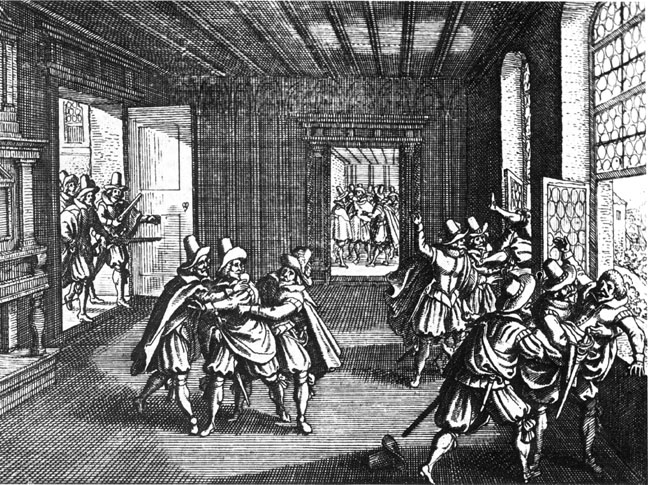
Of all the ridiculous things that have happened in history, the Second Defenestration of Prague is probably my favorite. The Czechs have a long legacy of throwing people out of windows (defenestrate: de - out of, fenestra - window), as they rightly should. I have heard rumors that defenestration was a semi-common form of punishment/rebellion in Europe, but that will require further investigation. It makes sense, though. I can just imagine the rich establishment, hanging out in their penthouses. What better way to make a point than to invade those upper reaches and toss out the denizens - a literal and figurative fall from power.
The first Prague window tossing goes all the way back to 1419. In this instance, a group of Hussites stormed the city hall over a dispute involving prisoners and chucked six or seven fellows out the window to their death below. This included some city council members and the burgomeister (aka, the mayor). Too bad. The Czech king at the time, Wenceslaus, supposedly died of the shocking news. And although you may be exclaiming at this very moment, "Ah yes! Good old King Wenceslaus! Poor chap!" don't get too excited. The king of Christmas fame lived quite awhile earlier - this one was known as "The Drunkard."
Then in 1483, the Praguians were at it again. Shockingly, it was another rebellion. This time, though, they killed most of the folks before flinging them out - a nice courtesy. Only one of them meritted live launching. For some reason, this defenestration is mostly forgotten and does not earn an official numbering. I sometimes feel bad for those rebels, going to all the trouble to cast people out a window and barely getting any credit. So although this was the second group of balcony ballast, the official Second defenestration came later.
For the next century and a quarter, there was a noticeable dearth of banister flipping. I imagine the Czechs were a bit put off by the lack of rebellion labeling. I mean really, what is the point of going to all that trouble if you aren't properly recognized? I would certainly be upset. But after a few generations, the offense was forgotten and the Praguians got back to it.
The year was 1618, Sir Walter Raleigh was busy with his hair gel, preparing to be beheaded, when the latest installment of Prague's greatest tradition went down. This time, it was much more serious, but nonetheless comic. Lending credence to the idea of being a common form of punishment, the victims were tried, and then calmly (well, maybe) found guilty and tossed. Luckily for them, a large pile of manure was waiting; justice was foiled by a heap of dung. Even though they didn't die, it still seems appropriate as a symbolic gesture. And it was of infinite importance, possibly inspiring one of the opening scenes of Aladdin, one of the most influential movies of the 20th century. As a side note, it also began the Thirty Years War (a few minor skirmishes between Catholics and Protestants, leading to the death of 15-20% of Germany - trifles really), whose most important historical consequence was the addition of Swedish king Gustavus Adolphus into western history textbooks. What a terrific name!
As you can see, defenestration is important. It starts wars, it's imaginative, and it makes a point. As a tribute to its historic glory, I have a plan to stage a dramatic reenactment during my European roamings with my wife. Prague is one of our must-see stops, and we will ensure a first floor hotel room; obviously, safety is a priority this time around. So basically, my wife is going to defenestrate me. It's simple and beautiful. We will be sure to record it, in video if possible but at least pictures, and post it for your enjoyment.
I hope you have enjoyed this brief look at one of the most important events in all of history. As a final note, the word defenestration was coined as a result of our Praguian friends' commitment to inventive punishment. So if you have any unique traditions (hopefully less harmful ones) that catch on, maybe you will have a Latin-based word coined on your behalf as well. Be sure to mention defenestration in your acceptance speech.


 Posts
Posts

