History and Truth

History gets a bad rap. Historians these days so often encase the most fabulous of stories in the drabbest apparel possible. I believe history serves two important functions primarily: to inspire us to love who we are and to prevent us from committing the same mistakes repeatedly. Our prior days would easily succeed at these two outcomes if historians hadn’t gone to pot and the public ceased to study the subject with any intent. I have never been less enthralled by any books than by the history textbooks I was forced to consume as a high schooler. Even Hemingway, whom I abhor, could not come close to the hellish experience of wading through The Enduring Vision, my US history textbook, and the book dubbed Gertrude and Bartholomew (actually, I don’t recall the two authors’ names, so these will have to suffice) by my European history class. I have nothing against the teachers of those classes, in fact, I rather enjoyed them. But the textbooks – complete refuse. Somehow they were justified by the breadth of information made available compared to other texts. But I say, bother the dates of so-and-so’s death. If I don’t lift my eyes from the textbook feeling the importance of my own history deep in my innards, but rather let my eyelids fall in stupefied slumber and drool proceed freely from my lips because of the utter boredom cast upon me, then the book is a failure, and the author should never again be consulted.

You see, harsh though I may seem, I absolutely love history, but I was never firmly sure of this truth until I encountered historians who were willing to add a bit of opinion to their interpretations without fear of scorn. History has become so wrapped up in unbiasedness that no one is willing to make a judgment or offer deeper significance to any event. In my opinion, it is the historian’s job to offer a pattern behind history, a logical series of events that explain why things happened, not just that they happened. It should then be the duty of the reader (or professor) to assess the validity of that historian’s interpretation. And the history should be interpreted in such a way that it can be applied to the present. For as we know, those who are ignorant of the past are doomed to repeat it.

Historians today seem to think it is good to prattle on endlessly about the common man, the everyday happenings of the peasants. Forgive me, but that is so unspeakably boring – how can anyone expect to catch the interest of a young boy with talk of the attire of a tanner in Plymouth? They want stories of war and glory, of adventure and triumph, even of loss and despair. But they simply don’t care about how many ounces of bread the average man ate daily in 1702. There’s a reason myths and fairy tales from ages past are still around, and there’s a reason why they still apply to current situations. History bears equally enthralling stories and applicable lessons if only we would teach them. All this nonsense about everyone’s perspective being equally valid has sucked the merit out of history. Truth is there, but it must be sought out and applied. That is why I love historians who are willing to offer their take on a situation, even if it is dead wrong, and actually believe what they say without shame. If they are wrong, and are proven so, I believe they would recognize their failure.

Here is an example of what I mean. Suppose I were to say the following, “Just as Christians killed countless ‘heretics’ before the Reformation took hold and slowly led to more peaceful sects and the resolution of doctrinal issues with fewer deaths, so Islam needs a reformation to end its violent sectarian nature.” Whether I am right or wrong, I am still opinionated and I am actively seeking truth. If instead I add the tag “but you may disagree; what is good for you is good for you,” then I have forsaken history. History is meant to be interpreted, and there are correct interpretations as well as false ones. But it is better to take an incorrect stance and willingly accept correction than it is to take no stance at all. At least if you take a stance you encourage others to find fault in it so that by and by your stance is honed and refined into something truly meritorious. If you allow for the correctness of all vantage points, no progress is ever made and you are left ignorant. Indeed, anyone would admit that it is foolish to say that 2+2=4 but that you may have your own equally correct opinion on the matter. People believing 2+2=5 need correction, not tolerance. I would rather be wrong from time to time taking an intellectual stand for something I hold true than fail to encourage inspection of truth by my fellow man; I do not want a society full of people willing to tolerate lies as relative truth.

Michael Ramsden, a smart fellow, quoted some other smart fellow about truth and it went something like this: if someone tells you there is no such thing as truth, he is asking you not to believe him, so don’t. Obviously that first clause cannot be ‘true’ if there is no such thing as truth, so there must be truth.

I am currently reading Black Lamb and Grey Falcon by Rebecca West, a sort of historical and cultural inspection of the Balkans via travelogue. It was written just as World War II was breaking out and West’s distaste for the Germans as a result is evident. Some believe that her bias taints her work too much to be considered good history. Although I have not read the entire work yet, her perception and understanding of history’s impact on the present is astounding and clear, and I much admire it. This is how history should be. It connects Balkan history back to Roman times and shows the clear sequence of events leading to current culture and attitudes. And what I especially enjoy is that she is very matter of fact: one event led to another, combined with another event, and voilà, a plausible reason why we have the current situation. She doesn’t beat around the bush or pander to her rivals; she clearly states her opinion as fact and moves on. It is clear that she would change her mind if you offered sufficient evidence to the contrary, but given the available information, she forms a blatant hypothesis and offers it in the face of all naysayers. This is the sort of history that inspires and the sort of writing that encourages others to find truth rather than admit all suggestions as reasonable. While all men are created equal, all ideas are not.

I would feel insufficient if I did not conclude with an equally direct statement. Thus, I will be clear. There is absolute truth. Regarding all truth as relative is an excuse to hide behind, an unwillingness to search and learn, an extreme laziness of mind. It is much easier to say everyone is equally right, and that’s why so many people do it. But it is simply ridiculous to say so and it yields nothing good. If all truth is relative, then how is it that Hitler or Stalin were wrong? It also seems that the relativists often have strong political leanings, but how is any politician better than another if there is no truth? It is all absurdity. Don’t fall for it. Have an opinion.

Georgia On My Mind

May I first apologize for my overly long delay in new thoughts. Apparently, moving across the Atlantic is a bit more time consuming than I had originally anticipated. But now, five days after our arrival in Oxford, my wife and I have found a sufficient new coffee shop with internet, and I am appropriately high strung on a double espresso (after a monster latté this morning) to write again. We are yet to establish internet in our flat, so posts may be slightly sporadic for the next week or two until we have steady web access. But thank you, dear reader, for coming back despite the wait. I am much obliged.

Today my wife and I were tourists. After a few preliminary errands, we visited the Ashmolean Museum. This lovely little institution is a microcosm of England. First of all, it encases the peculiarity of English names in eternity. Elias Ashmole was the patron of the museum. His name conjures up all sorts of hideousness to my mind. Some old chap, sitting around in a parlor sipping tea with a gigantic mole on his face, the colour of ash - that is Mr. Ashmole to me. To top it off, the collection that he donated to found the museum was not actually his. He merely inherited it. But of course, that is most appropriate for this land, where inheritance has been an important segregator for centuries. I'm sure he was an excellent man, though, having donated everything to the public. And I did rather enjoy the museum, which, much to my happiness, was completely free.

Although inheritance may have served an unjust purpose for some time here, shutting worthy people out of public positions and the like, it also served admirable purposes. This town, Oxford, has inherited so much history and lore that one can hardly escape it at any turn. Even the cookers (ovens) are ancient. My wife and I have discovered that to live in Oxford is to trade history for amenities. After all, it would be rather difficult for everyone to live in houses cut from single slabs of ancient stone (well, maybe) and have central heating. I can't imagine how hard it would be to cut through all that rock and leave the buildings intact. So although the "furnished to a high standard" flat may not have met our American expectations, it is housed in a wonderfully picturesque building. In my opinion, all the history makes up for the unfortunate cooker and heating.

But to live anywhere, one must have friends. We have realized this to an absurd degree this week. Having arrived earlier than most students, we have hardly met anyone this entire week and feel the dearth of society keenly. Hopefully this will change as the term starts and we get more involved with my college. And we can tell that the people are friendly - café owners and store clerks have all been most eager to help. But it is nonetheless lonely.

I imagine that this feeling would accompany anyone moving to an unknown city, even within their native land. But to cross an ocean and enter a completely different land is slightly more daunting, I believe. Travel writers seem to have neglected these feelings, perhaps because they never intend to stay. At times it feels like we are visitors, but we have no homey hearth awaiting us after checking out from the local hotel. We actually go home to that old victorian building that looked so nice for our pictures. What was so lovely and romantic suddenly becomes a bit less than accomodating. The culture that was so quaint and historic, the same one we would marvel at as a short-term traveler, suddenly becomes a wall setting us apart as outsiders.

A year ago, my then fiancée and I had lunch with a couple who had lived in Budapest for four years and then come back to the states permanently. One thing they said is that if we lived in a foreign land, no matter how long, we would never quite fit in as locals. There would always be something setting us apart and keeping us from completely assimilating into the local life. But then, on returning to our native land, we would find that something was different. Our perspective was changed so that we could not lead the same life we had before. We would be people without a country - always endeared to our homeland, but feeling a bit of nostalgia for our adoptive country elsewhere. I don't know if that will be quite the same for us as it was for them, as Britain and Hungary are rather different places, but the idea of home is certainly a tough one, and I imagine it will become more complicated when we grow more comfortable here.

I have always been enamored with terms often used by Europeans like homeland, heartland, fatherland, motherland, native country, etc. Americans don't seem to use them as often for some reason, perhaps because it is so easy to never leave America. It would be difficult to be born in Slovakia and never leave, and upon leaving, the nostalgia of the homeland is quickly noticeable. Particularly among Eastern Europeans, the idea of a homeland seems especially powerful, producing such famous pieces of music like Finlandia (Sibelius), Ma Vlast (Smetena), Romanian Rhapsody (Enescu), and many others. And now I begin to feel the emotion that runs through all these pieces, of nationalistic pride and the glory of the native country. To leave your country, especially knowing you will not be back any time soon, is to understand how deeply you love your country. No matter how much I grow to love Oxford, Georgia will always be my homeland. Nothing could ever destroy my affection for the brief drive to Athens from Atlanta, of the beauty of Savannah, of the North Georgia mountains. So from Oxford to Budapest, from Oslo to Istanbul, wherever I go on this adventure, Georgia will be on my mind.

The Big Move

Welle, the daye ha∫ finally comme, after many month∫ of preparation. To-morrow, my wiffe and I leave for England. In honour of the momentou∫ daye, I leave you with a poem by one, John Donne, in who∫e spellinge I hope these fir∫t few sentences have been rendered. Though thi∫ poeme i∫ intended for Donne'∫ wiffe (I believe), not familye and friende∫, it i∫ ∫till a marvelous poeme. Hope you enjoye it. Check back soone!


"A Valediction: Forbidding Mourning" by John Donne

As virtuous men passe mildly away,
And whisper to their soules, to goe,
Whilst some of their sad friends doe say,
The breath goes now, and some say, no:

So let us melt, and make no noise,
No teare-floods, nor sigh-tempests move,
T'were prophanation of our joyes
To tell the layetie our love.

Moving of th'earth brings harmes and feares,
Men reckon what it did and meant,
But trepidation of the spheares,
Though greater farre, is innocent.

Dull sublunary lovers love
(Whose soule is sense) cannot admit
Absence, because it doth remove
Those things which elemented it.

But we by a love, so much refin'd.
That our selves know not what it is,
Inter-assured of the mind,
Care lesse, eyes, lips, and hands to misse.

Our two soules therefore, which are one,
Though I must goe, endure not yet
A breach, but an expansion,
Like gold to ayery thinnesse beate.

If they be two, they are two so
As stiffe twin compasses are two,
Thy soule the fixt foot, makes no show
To move, but doth, if the'other doe.

And though it in the center sit,
Yet when the other far doth rome,
It leanes, and hearkens after it,
And growes erect, as that comes home.

Such wilt thou be to mee, who must
Like th'other foot, obliquely runne;
Thy firmnes drawes my circle just,
And makes me end, where I begunne.

The Battle of LeChèque

A few days ago I went to Macaroni Grill with a most venerable man, the BM Joe (best man, that is). We had a fine time eating and chatting and whatnot and then our server, named Justin, came to ask us about our checks. I of course told him we would like separate checks, as is the usual custom. Then however, Joe leapt in his seat and said "Forsooth, no! I shall only accept it, which having been summed together, is contained solely in a single bill. Neither two nor three shall do, saving they are all given to me; nay, neither four nor five shall be the counting. Only one, prohibiting procession thereafter, and it shall be produced to me, and myself singly." After such graceful verbage, I could hardly refuse his generous offer; of course, I put up a very minor skirmish, but it was obvious there would be no victory on my part. However, on the occasion of our next dinner, I will be better prepared for battle.

So we played out yet another instance of the ongoing, glorious struggle for control over one's restaurant bill. For years I have been an onlooker: my father is constantly laying siege to my grandparents' established control of the check, and although he does win out from time to time, he seldom gains the upper hand for long. It has all the makings of a real war, complete with flanking tactics, sneak attacks, and full frontal assaults. There's the classic, approach-the-waiter-ahead-of-time ploy, which can be successful if properly executed. Then you can always leave cash in some inconspicuous location that the host will only find after you have left the state. Or you can blatantly shove money into the purse, pocket, or hands of whoever you battle and refuse to take it back, simply leaving it on the couch if it is subsequently thrust back at you.

There are all sorts of understood rules also. Once the money has touched another person, it becomes their possession, and we all know that if the payback-er can manage to get the money onto the living room floor and sneak out the door, the resident will pick it up at some point and use it. However, there are special ops moves that can prevent the efficacy of such tactics. My father-in-law, for instance, with his military background, is an expert in covert attacks. More than once my wife and I have found money tucked away in some place we only check a few times a month, like the small storage space underneath the armrest in the car, or perhaps the drawer containing my toothbrush. Mighty clever, if I do say so myself. Or sometimes it works best to place money in such an obvious spot that the person is unlikely to realize it for a bit, even though frequently seeing it. For example, I have known my father to leave money on the mantle over my grandmother's fireplace as we head out the door.

To top it off, home-field advantage is definitely a factor. My grandparents nearly always succeed in paying when we are visiting them, but my parents are much more likely to win the check when their parents visit here in Georgia. And just as in 18th century warfare, battlefield etiquette plays a powerful role. There is a point where one must give up, specifically after three no-you-mustn't-s, two sighs of dismay, a stern warning that you will be paying next time, and of course, profuse gratitude, though Mesdames Post and Vanderbilt are shockingly silent about the precise number of thank yous required.

In a day when duels are frowned upon and we no longer have the good sense to take turns exchanging salvos with the enemy in war, the Battle of LeChèque, as I call it, is one of few remaining vestiges of decorous struggle. And continue it must! It is a great tradition, full of vague truisms and beautiful formalism, wrapped up with the human need to display one's independence and ability to provide. One could not ask for a more telling image of the relationship between generosity and self-sufficiency. And best of all, everyone seems to end out on top: either your meal is graciously paid for, or you have been given the opportunity to display your generous nature and your goodwill toward the other. Since the paying hand seems to balance out with time, both parties are able to experience each sentiment equally and everyone wins.

In these last pre-Oxford days, friends and family have been exceedingly generous with my wife and me, and we are most grateful. Many say that Europe is quite different from the US, pointing to a lack of joy and happiness, and I think if this is true, it is a direct outcome of their lack of potluck dinners. Maybe potlucks have become the rage in Europe since my last visit, but even if not, we can show our munificence in the restaurant. We must continue to show ourselves capable, both of provision and of generosity, for in my opinion, these two causes are chiefly why we labor. I may not be able to duel with the likes of Aaron Burr, but I nonetheless know the meaning of honor. So both in Oxford and back in the US afterward, I hope to be a frequent wager of the Battle of LeChèque.

Saying Goodbye

Don't get too excited. Despite this post's title (and your soul's deepest desire, no doubt) I am not terminating this blog. You're still stuck with me.

Righto - let's begin shall we:

I find it unfortunate that English has failed to keep the distinctions that are availed to speakers of many other languages in saying goodbye. Although we can say bye, goodbye, see you later, farewell, until we meet again, etc., and they do all have slightly different connotations, I believe the general public does not clearly distinguish between which phrases should be used when. For instance, in French, you simply do not say adieu unless you do not know when you will next see the person with whom you speak. You literally entrust the person "to God" because only he could know what happens next. In German, I believe you would use auf Wiedersehen for the long-term goodbye, meaning roughly "until we meet again" (lit. "until next seeing"). I particularly like this one because of how vague it is. Until we meet again...I will think of you every night? Or perhaps, until we meet again, I will eat three meals daily? And then what if your implied promise is broken? It adequately captures the uncertainty - who knows what I'll be doing, but I'll be doing it, and I hope I'll see you again sometime thereafter. I find it extremely appropriate.

But for English speakers, particularly in America, saying goodbye can be awkward and embarassing if not properly thought out. I don't mean this to be harsh, but it doesn't really work to say see you later when it is very likely that you won't ever see the person again. It implies a complete lack of concern and understanding of the fact that the person is really leaving. And therein lies the issue. Although farewell carries a bit more finality than the others, it would not be unusual to hear someone using any of the other forms in both short-term and long-term settings. I think it would be best if until we meet again and farewell were reserved for long-term goodbyes to preserve their emotional connotation. Frankly, it is nice to feel like someone really does want you to "fare well," not merely be seen later. Likewise, it would be terrific to hold out hope that you would "meet again" with someone you believed was hoping the same. But see you later is naive and unrealistic, as if the speaker is sure he will see you later and thus is not required to feel any emotion at your departure. Nothing has changed - you'll see each other in a week or two, maybe do lunch. Then when that lunch never occurs, the speaker pleads ignorance. His plea is correct.

I realize, though, that sometimes people can have completely proper motives and are just awkward. I know this because I am definitely one of those people. In important final moments, I lose my ability to reason and just blurt out what I'm used to saying, which is normally "see ya later." And after that, it's either deal with it, or try to correct the blunder and become even more awkward in the process. So generally I opt for the former. You see, my problem is that I have never really had to say goodbye like this before. It was traumatizing enough for me to move from private middle school into a public high school where few of my friends were continuing their education. But we all still lived in the same places. Then there was high school to college, which was not very difficult because I could come home whenever I wanted.

That leaves now, and this time it's for real. If I'm going to see anyone, it will require an eight hour flight and an hour in a train. And although I have tried to adequately say farewell to various people in the past month, I think a piece of music sums it up better than I was ever able to communicate with speech. Beethoven's Les Adieux Sonata (No. 26) for piano opens with a movement called "Das Lebewohl," roughly translated to "the farewell," though Germans would say it means much more than that and cannot really be translated. I have only heard the entire sonata a handful of times, but I often play the first three chords because they express what I feel better than I am otherwise able. For those of you who play the piano, here is the beginning of the piece (sorry it's so small):
The first time I heard the piece I was truly struck by how well the opening chords perfectly sum up what it is to say goodbye, permanently. Although the progression is not unique, there is something painfully fitting about the transition from the simple major chords in the first measure, to the unfortunate, minor chord in the second. It feels like Beethoven is watching his lifelong love leaving in a carriage - I'm ok; I'm still ok; I'm definitely not ok. And in this case, the composer really spells it out for us: you will notice that above the first three chords he writes "Le-be-wohl," as if he specifically intended those three chords to signify everything that farewell connotes. Although Beethoven goes on to develop his notion of farewell throughout the piece, I feel sufficiently moved after the opening chords that I normally stop and soak it up. He must have had a very moving farewell at some point in his life - there is no other way he could so perfectly infuse three, elementary chords with such an effect.

So some of you reading this may have received a farewell from me that was lacking in appropriateness, and I do hope you will overlook my awkwardness. I assure you that any "see you laters" and "ciaos" were entirely a result of my inexperience in such times. (I do hope to be better the next time I leave some place for a long period). So to all my friends and family, I will miss you much and think of you often. It is difficult to leave despite the excitement, and I know I will have some "I'm definitely not ok" moments before settling into my new life. But life goes on, and I know eventually we get passed those first three chords and into the rest of the music. And there sure is a lot of music after that introduction.

There will always be vacancies on our floor for your sleeping bags.

Farewell.

To Be Thrown Out a Window


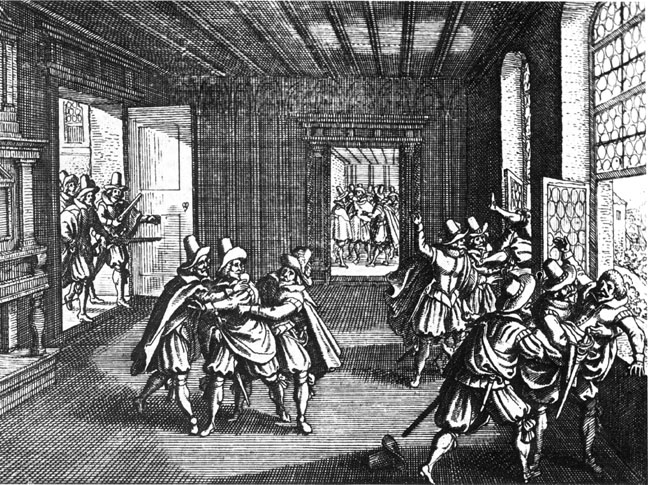
Of all the ridiculous things that have happened in history, the Second Defenestration of Prague is probably my favorite. The Czechs have a long legacy of throwing people out of windows (defenestrate: de - out of, fenestra - window), as they rightly should. I have heard rumors that defenestration was a semi-common form of punishment/rebellion in Europe, but that will require further investigation. It makes sense, though. I can just imagine the rich establishment, hanging out in their penthouses. What better way to make a point than to invade those upper reaches and toss out the denizens - a literal and figurative fall from power.

The first Prague window tossing goes all the way back to 1419. In this instance, a group of Hussites stormed the city hall over a dispute involving prisoners and chucked six or seven fellows out the window to their death below. This included some city council members and the burgomeister (aka, the mayor). Too bad. The Czech king at the time, Wenceslaus, supposedly died of the shocking news. And although you may be exclaiming at this very moment, "Ah yes! Good old King Wenceslaus! Poor chap!" don't get too excited. The king of Christmas fame lived quite awhile earlier - this one was known as "The Drunkard."

Then in 1483, the Praguians were at it again. Shockingly, it was another rebellion. This time, though, they killed most of the folks before flinging them out - a nice courtesy. Only one of them meritted live launching. For some reason, this defenestration is mostly forgotten and does not earn an official numbering. I sometimes feel bad for those rebels, going to all the trouble to cast people out a window and barely getting any credit. So although this was the second group of balcony ballast, the official Second defenestration came later.

For the next century and a quarter, there was a noticeable dearth of banister flipping. I imagine the Czechs were a bit put off by the lack of rebellion labeling. I mean really, what is the point of going to all that trouble if you aren't properly recognized? I would certainly be upset. But after a few generations, the offense was forgotten and the Praguians got back to it.

The year was 1618, Sir Walter Raleigh was busy with his hair gel, preparing to be beheaded, when the latest installment of Prague's greatest tradition went down. This time, it was much more serious, but nonetheless comic. Lending credence to the idea of being a common form of punishment, the victims were tried, and then calmly (well, maybe) found guilty and tossed. Luckily for them, a large pile of manure was waiting; justice was foiled by a heap of dung. Even though they didn't die, it still seems appropriate as a symbolic gesture. And it was of infinite importance, possibly inspiring one of the opening scenes of Aladdin, one of the most influential movies of the 20th century. As a side note, it also began the Thirty Years War (a few minor skirmishes between Catholics and Protestants, leading to the death of 15-20% of Germany - trifles really), whose most important historical consequence was the addition of Swedish king Gustavus Adolphus into western history textbooks. What a terrific name!

As you can see, defenestration is important. It starts wars, it's imaginative, and it makes a point. As a tribute to its historic glory, I have a plan to stage a dramatic reenactment during my European roamings with my wife. Prague is one of our must-see stops, and we will ensure a first floor hotel room; obviously, safety is a priority this time around. So basically, my wife is going to defenestrate me. It's simple and beautiful. We will be sure to record it, in video if possible but at least pictures, and post it for your enjoyment.

I hope you have enjoyed this brief look at one of the most important events in all of history. As a final note, the word defenestration was coined as a result of our Praguian friends' commitment to inventive punishment. So if you have any unique traditions (hopefully less harmful ones) that catch on, maybe you will have a Latin-based word coined on your behalf as well. Be sure to mention defenestration in your acceptance speech.

Ah, words!

Some old guy, Poe or Shelley or someone, said that cellar door was the most beautiful word in the English language. I have two problems with that. First of all, it's two words. Secondly, although it is evocative of darkness and mystery and fear, all of which I find exciting in a literary sense, I believe it to be, at best, the penultimate in terms of beauty. In my opinion, the most beautiful of words must be medieval. Then perhaps cellar door, and then the antepenultimate might be defenestration. But penultimate and antepenultimate seem deserving as well. So many words, so few top three rankings.

Medieval is such a terrific word to me because of all its connotative desserts which I have enjoyed from an early age. Obviously, I hadn't the slightest idea of how to spell it as a child, so I naturally assumed it was mid-evil, in the middle of evil. Those were trying times, as we all know, so my spelling made sense - evil days deserve evil spellings. Eventually I learned how to spell it properly, but the dark, foreboding sense of the earlier spelling lingered on. Even now the correct spelling conjures up images of magic, fairy tales, and perpetual night. And that is what I love about the word. The Middle Ages (medium - middle, ævum - era, age) were saturated in myth and legend of such diversity and scope that no one could ever know them all. But they were all astonishingly real to the listeners. There really were underwater kingdoms, wailing banshees, and thundering gods in the storm. And being the romantic that I am, these are all wonderful things. Even today I firmly believe myth provides deep insight into the nature of man (see "On Fairy Stories," available in the book Tree and Leaf by JRR Tolkien, for one exceptional explanation) and is a worthwhile study for the classroom, despite our greater understanding of the world around us. So what is there not to love about medieval? It is a perfect word.

But the multitude of striking words in the English language is fabulous. Penultimate and antepenultimate, meaning second-to-last and third-to-last respectively, are great words too, but for a completely different reason. I learned these words in the context of music, where they are used to describe the few closing measures of a piece, since the end is often of special importance. They are completely unnecessary, and that's why I love them. Even with hyphens, third-to-last has fewer letters than antepenultimate, and it has the added benefit of preventing embarassment when the author realizes too late that he actually published antipenultimate. So instead of occuring in the third-to-last measure, the noted feature is very obviously anti the penultimate measure, truly at war with it. Music scholars may note that the occasional belligerence of the misspelled term does not detract from the correct term's precision. But in music, you can also always just provide the exact measure number. I suppose it is exciting, though, when a composer's music goes off to war against itself. So despite the possible confusion and snobbish air of the word, or rather, because of those very traits which render the words so silly, I love them.

English does not only provide its speakers with scholarly words that are absurd and marvelous, it also provides the rare gift of everyday words with special twists. Take for example, the instance pointed out to me by my good friend Paul. In reading my earlier blog about pop singers rhyming thing with thing and minute with minute, he suggested that artists are allowed to rhyme a small subset of words with themselves. And he is absolutely correct. One such example is the word orange, which has no rhyming words in English. So obviously if you want to rhyme it, it must rhyme with itself. I had previously heard that silver and purple also fall into this category and began to think that maybe there was some sort of color monopoly on anti-rhyme. But after some research, I discovered that silver rhymes with chilver (a female lamb) and purple with curple (a horse's hindquarters) and hirple (to walk lamely - whatever that means). Try using one of those in conversation at work on Monday and see what sort of looks you get! There are a few others too, and I will now attempt a sentence with as many as possible:

The plankton-eating sasquatch, upon finding yttrium on his uvula, stood from the toilet on the plinth to seek the sacred ninja penguin's advice on whether, as a bachelor, he should vacuum his home to avoid allowing jejune protists from spoiling the celestial syzygy that evening.

I simply do not think I can continue - that was way to much fun. Defenestration will have to wait until next time. Until then, beware of bulbous chimneys!